
There is a popular narrative in India that our young and growing population is one of our greatest economic advantages. However, I am not convinced. In fact, I think we may be confusing population with productivity.
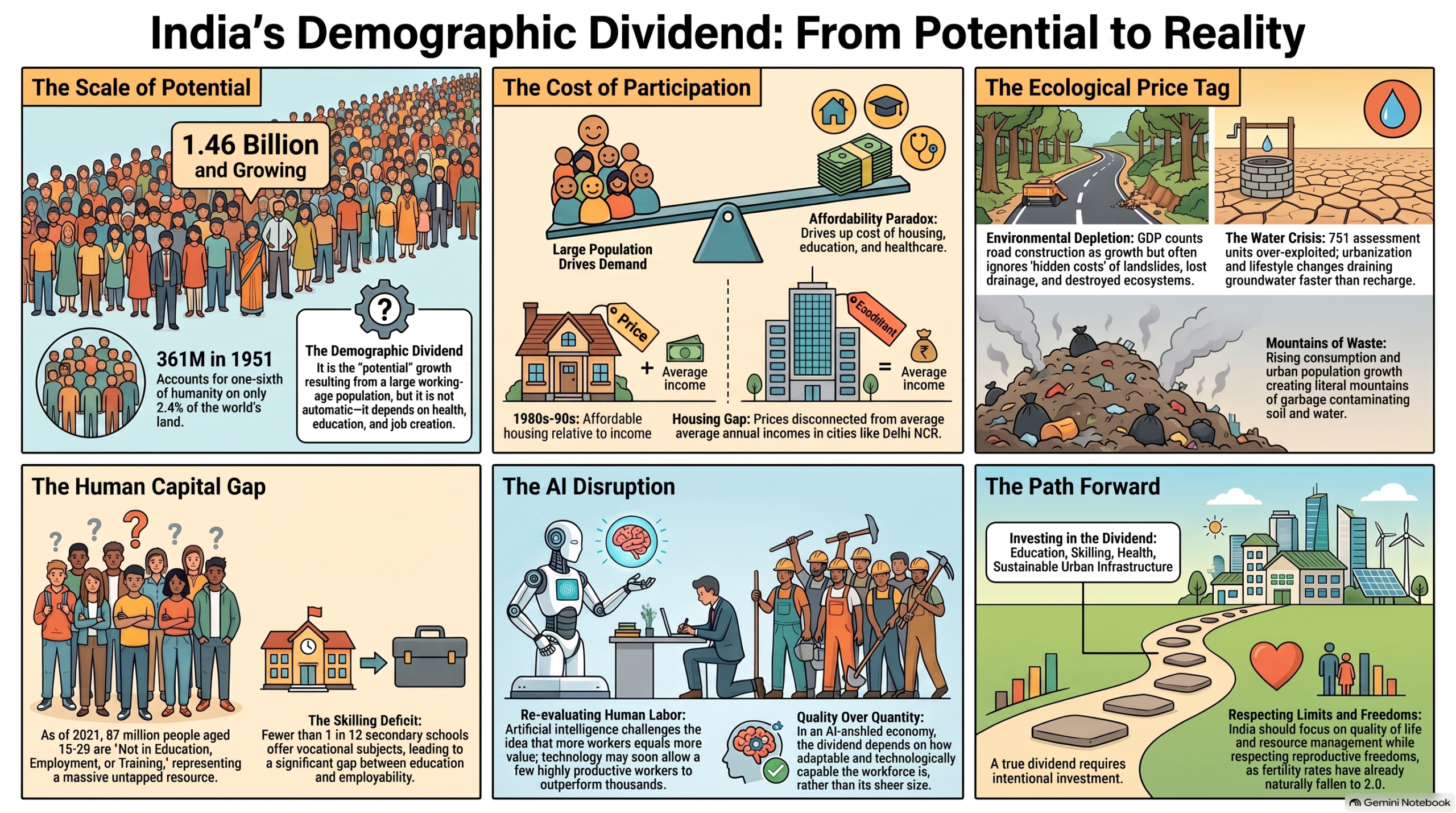
India had a population of approximately 361 million in 1951. Today, the country’s population is around 1.46 billion. That is more than four times the population we had at Independence. Today, roughly one in six people on the planet lives in India, while India accounts for only around 2.4% of the world’s land area.
The usual argument is that this is a demographic dividend. A large working-age population means more workers, more consumers, more economic activity and, potentially, faster economic growth. While that is also true, but there is an important word that often gets lost: Potential.
A demographic dividend is not created simply by having a lot of young people. It is an opportunity that depends on investments in health, education and infrastructure, along with an environment capable of creating productive jobs. And that is where I think India needs to ask some uncomfortable questions.
More people also mean more pressure on scarce resources
India’s enormous population has undoubtedly contributed to economic growth. More people create demand for food, housing, transportation, consumer goods and services. A large labour pool can also provide businesses with access to workers at scale. But there is another side to this equation.
More people also mean greater demand for housing, roads, public transport, water, electricity, healthcare, schools, parks and other civic infrastructure. And when supply does not keep pace with demand, prices rise.
I grew up in Delhi in the 1980s and 1990s. One of the things that has changed dramatically since then is the relationship between household income and the cost of housing. I remember a time when buying a house or flat in Delhi, while certainly not cheap, appeared considerably more achievable for a middle-class family relative to its annual income.
Today, housing in many parts of Delhi NCR can require a multiple of annual household income that feels completely disconnected from the affordability equation for an average middle-class family.
This isn’t just a housing problem. Education is getting increasingly expensive and even healthcare can impose enormous financial burdens. And as cities become more crowded, even something as basic as access to open spaces and recreational facilities becomes harder and more expensive to provide.
Population growth has therefore produced an interesting paradox. The same population that creates economic demand can also increase the cost of participating in the economy.
There is another dividend we rarely talk about: the environmental cost
There is one more dimension to this debate that deserves far more attention.
What does a population of 1.46 billion people do to a country’s natural environment?
To be clear, population is not the only reason for India’s environmental problems. Poor urban planning, weak enforcement, inefficient agriculture, unsustainable consumption and inadequate waste management all play major roles. But population amplifies the pressure as every additional person needs food, water, housing, energy and transportation. Every additional person also produces waste. And we are beginning to see the consequences all around us.
Look at our hills
Some of India’s most fragile ecosystems are increasingly being commercialised to accommodate tourism, second homes, hotels, roads and other infrastructure. The hills were never designed to support the scale of construction and traffic that some destinations are now experiencing.
Forests are cleared. Slopes are cut. Natural drainage channels are altered. Roads and buildings replace vegetation that once helped stabilise the soil and absorb rainfall. And then, when a landslide or flash flood occurs, we call it a natural disaster. Sometimes it is. But sometimes the “natural disaster” is partly a consequence of how aggressively we have modified the natural environment.
The irony is particularly striking in the Himalayas. We go to the mountains looking for clean air, forests, rivers and solitude. And then we build exactly the kind of cities, roads, hotels and commercial infrastructure that destroys the characteristics we went there to experience. There is a fundamental ecological limit that we seem reluctant to acknowledge:
Not every beautiful place needs to become a tourist destination for millions of people. And not every tourist destination needs another hotel, resort, apartment complex or four-lane road.
Our cities are producing mountains of their own
If the hills are being buried under concrete, our cities are producing another kind of mountain. Garbage.
India’s urbanisation and rising consumption are creating an enormous waste-management challenge. We have become accustomed to seeing enormous landfill sites on the outskirts of our cities. Mountains of garbage have become part of the Indian urban landscape. We generate waste, transport it somewhere outside our immediate field of vision and call the problem solved, which unfortunately it isn’t.
Landfills consume land. They can contaminate soil and groundwater. They generate methane and other emissions. They attract pests and create serious health and environmental concerns. And as India’s population and consumption continue to grow, the scale of the problem grows with them.
This is not simply a question of whether citizens should segregate their waste. The deeper question is whether an increasingly urbanised country can continue with a model in which we consume resources, generate waste and then look for another piece of land on which to dump it.
Then there is water
Perhaps the most worrying pressure is on something we cannot manufacture: Water.
Groundwater supports a huge proportion of India’s agriculture, industry and domestic consumption. Yet groundwater extraction is already putting significant pressure on the resource. The government’s 2024 groundwater assessment classified 751 of 6,746 assessment units as over-exploited, representing 11.13% of the total. Another 206 were classified as critical. The problem is not simply that India has a lot of people.
It is that more people are increasingly living in cities, consuming more water and demanding lifestyles that require enormous quantities of water indirectly. A glass of water is obvious. The water required to grow food, produce electricity, manufacture goods and construct buildings is much less visible.
We are also seeing lakes, wetlands and traditional water bodies disappear or deteriorate under the pressure of urbanization and encroachment. When a lake disappears, we don’t just lose a scenic feature. We lose groundwater recharge capacity, flood-buffering capacity, biodiversity and an important part of the local water cycle. And then, during the next extreme rainfall event, we wonder why cities flood.
The uncomfortable contradiction
This creates an uncomfortable contradiction in the demographic dividend argument. We celebrate having more people because they create more consumers and more workers. But those same people also require more land, more water, more energy, more roads, more housing and more waste disposal.
There is nothing inherently wrong with any of those requirements. The problem arises when the rate of human demand exceeds the capacity of the natural and built environment to absorb it. At some point, the economic benefit of additional consumption can be offset by the cost of providing the infrastructure and repairing the environmental damage. And those costs are rarely included when we talk about GDP growth.
We count the construction of a road as economic activity. We don’t necessarily count the loss of natural drainage or the increased landslide risk created by cutting into a fragile slope. We count consumption as economic activity. We don’t always count the cost of collecting, transporting and disposing of the waste generated by that consumption.
We pump groundwater to support cities and agriculture but the depletion of the aquifer does not appear on a household’s monthly water bill.
GDP captures economic activity much better than it captures environmental depletion.
And that is why the demographic dividend conversation needs another metric:
What is the ecological cost of supporting the additional population?
India’s challenge is not simply to make 1.46 billion people prosperous. It is to make 1.46 billion people prosperous without destroying the natural systems that make prosperity possible in the first place.
But perhaps the bigger problem is what we do with all these young people
This is where the demographic dividend argument becomes even more interesting. We often hear that India has millions of young people entering the workforce and that this gives us an enormous economic advantage. But are we actually converting these young people into productive human capital?
A recent NITI Aayog report identified approximately 8.7 crore people aged 15-29 as NEET, meaning they were not in education, employment or training, based on 2021 data. There is an important caveat here. These 8.7 crore people should not simply be described as 8.7 crore unemployed young Indians. The NEET category includes people engaged in domestic duties, household enterprises, voluntary work and other activities. But that clarification does not make the underlying issue disappear.
It actually raises a more important question: How effectively are we converting India’s enormous youth population into productive economic participation?
NITI Aayog itself points to significant gaps in the transition from education to employability and notes that fewer than one in twelve secondary schools currently offer vocational subjects.
So perhaps the problem isn’t that India has too few young people. Perhaps the problem is that we have not yet built an education, skilling and employment ecosystem capable of making the most of the young people we already have.
And now AI changes the equation
There is another assumption behind the demographic dividend narrative that deserves reconsideration.
For decades, having a huge workforce was seen as an advantage because economic growth required large numbers of workers across manufacturing, services, including back offices, and construction. But technology has progressively reduced the amount of human labour required to produce a unit of economic output.
Artificial intelligence could accelerate that trend.
I am not suggesting that AI will simply eliminate jobs. History suggests that technology also creates new industries, new occupations and new forms of employment. But this time, there is a genuine reason to be uncertain.
We are still figuring out where large-scale AI, and potentially artificial general intelligence (AGI), could take us over the next few years. The impact on employment could range from relatively modest displacement to a fundamental restructuring of how human labour fits into the economy.
So, for now, I am crossing my fingers and hoping for the best. But even without knowing exactly where this leads, AI challenges the simplistic assumption that having more people automatically means having more economic value.
The relevant question in an AI-enabled economy may increasingly be less about how many workers we have and more about how productive, adaptable and technologically capable those workers are. A hundred highly productive workers may ultimately be more valuable than a thousand low-productivity workers.
And we are already beginning to imagine an even more radical possibility: the billion-dollar solopreneur.
An individual entrepreneur, equipped with AI agents and other technology, could potentially operate a business at a scale that would previously have required dozens, hundreds or even thousands of employees.
Whether that becomes commonplace or remains an extreme example is impossible to know today. But the direction is important. If technology allows a much smaller number of people to generate much larger amounts of economic output, then simply having a very large workforce may no longer be the economic advantage it once was.
The demographic dividend, therefore, cannot just be about the number of people entering India’s workforce. It has to be about how much productive value those people can create in an economy where the relationship between humans, technology and work is changing rapidly.
Population Control?
There is another important point that complicates this discussion. India’s fertility rate has already fallen substantially. According to NFHS-5, India’s total fertility rate is now approximately 2.0 children per woman, below the conventional replacement level of 2.1.
So this is not an argument for panic. Nor am I suggesting that India needs coercive population-control policies. In fact, the opposite. India is a democracy, and individuals should retain the freedom to decide whether to have children and how many children to have.
China’s forced one-child approach is neither desirable nor something India should attempt to replicate. Economic conditions are already influencing family size. As the cost of raising children rises, many families are naturally choosing to have fewer children.
We can see that transition happening. But that brings me to a more controversial proposition.
Should public policy subsidise larger families?
I believe we should seriously debate whether government benefits should continue to increase with family size. I am not arguing that a child should be denied basic rights or essential healthcare because of the number of siblings they have. But perhaps there is a reasonable distinction between universal entitlements and additional family-size-linked subsidies or benefits.
As a broad principle, government policy could favour households with up to two children when allocating discretionary family-size-linked benefits, with clearly defined exceptions for genuine medical and humanitarian circumstances.
Why? Because government resources are not unlimited. If a family voluntarily chooses to have a significantly larger number of children, should taxpayers necessarily bear an increasing share of the resulting economic cost?
That is not a question about controlling reproduction. It is a question about where public money should be directed. And perhaps the policy conversation should move from:
“How do we stop people from having children?”
to:
“How should society allocate scarce public resources while respecting people’s freedom to choose their family size?”
So, is India’s population a dividend?
My answer is: It can be. But population itself is not the dividend. The dividend comes from what we do with our people. If we educate them well, skill them, keep them healthy and create productive employment, a young population can accelerate economic growth.
If we build enough housing, transport, schools, hospitals and public spaces, population growth can translate into a larger and more prosperous market. And if we manage our land, water, forests and natural resources intelligently, economic growth does not necessarily have to destroy the environment.
But none of these outcomes is automatic. A large population can also mean unaffordable housing. It can mean enormous pressure on infrastructure. It can mean millions of young people who never make the transition from education to productive employment. It can mean depleted groundwater, disappearing lakes, shrinking green spaces and mountains of urban waste. And in an age where artificial intelligence is likely to change the relationship between economic output and human labour, we should be particularly careful about assuming that more people automatically means more economic strength.
Perhaps we have spent too much time asking: “How can India take advantage of its demographic dividend?”
And not enough time asking: “Have we actually created the conditions for a demographic dividend to exist?”
I am not advocating coercive population control. People must remain free to decide whether and when to have children. But freedom of choice does not mean government has to subsidise every possible choice indefinitely. We can respect reproductive freedom while having a serious debate about how taxpayer-funded benefits are structured, particularly where family size is directly relevant to the benefit.
And we can stop treating population growth as an unqualified economic good. Because ultimately, the objective should not be to maximize the number of Indians. It should be to maximise the quality of life, productivity and opportunities available to every Indian, while leaving enough natural resources for the generations that follow. And if we get that wrong, the demographic dividend could become a demographic liability.
Sources referred to for this post.
Census of India: Population Tables
World Bank: The Demographic Dividend, Opportunity and Risk
NITI Aayog: Reimagining Skilling for Viksit Bharat@2047
PIB: Government reiterates commitment for reimagining skilling
NITI Aayog: Environmental and Urban Sustainability Report
PIB: Groundwater Assessment 2024
World Bank: To Achieve India’s Bold Vision for the Future, It Must Tackle the Jobs Challenge