
For years, one of the most convenient things about UPI has been that it feels almost completely free. Launched in April 2016, the Unified Payments Interface (UPI) has completed 10 years in 2026 and has revolutionized digital payments in India. Whether I am buying vegetables from a local vendor, paying a restaurant bill, transferring money to a friend or buying something expensive, I can simply scan a QR code and pay. There is no need to carry cash, find an ATM or worry about whether the shopkeeper has enough change. All of this, without any charges (so far).
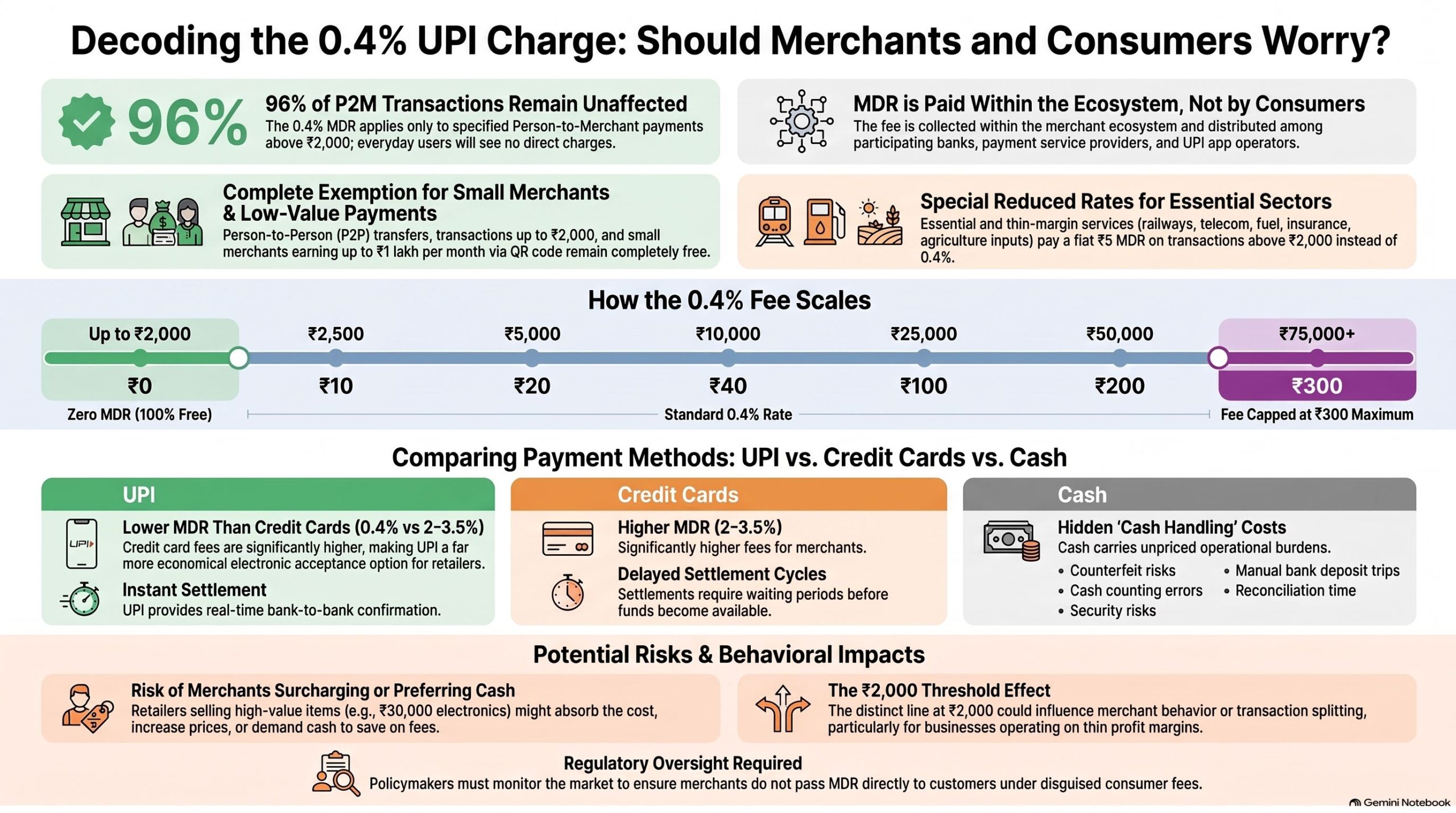
That model is now changing for some merchant transactions. From October 15th, 2026 (now postponed to after Diwali 2026), a Merchant Discount Rate, or MDR, of 0.4% will apply to specified UPI person-to-merchant transactions above ₹2,000. Importantly, this does not mean that consumers will be charged 0.4% when they make such payments. MDR is a charge within the merchant payment ecosystem. The government says it will be distributed among participating banks, payment service providers and UPI application providers.
There are also important exceptions. Person-to-person UPI transactions remain free, payments to merchants up to ₹2,000 remain free, and small merchants receiving up to ₹1 lakh per month through UPI QR under the specified category will continue to receive zero-MDR treatment. The government estimates that about 96% of P2M transactions will remain unaffected.
So, is this good or bad for UPI? As usual, the answer is more complicated than the headline.
Why was UPI free in the first place?
Before discussing the new MDR, it is worth remembering that “free UPI” was not the same thing as “cost-free UPI.” Banks, payment service providers, technology companies and other participants still had to operate the infrastructure required to process billions of transactions.
The difference was that the cost was not being recovered through a conventional merchant fee, Government support has been used as part of this model. For example, the government approved a ₹1,500 crore incentive scheme for low-value BHIM-UPI merchant transactions for FY 2024-25.
That approach made sense when the priority was encouraging people and merchants to adopt digital payments. But UPI is no longer an experiment. It has become a major part of India’s payment infrastructure. In FY 2025-26, UPI processed more than 24,000 crore transactions, according to the Ministry of Finance.
At that scale, the question of who ultimately pays for the infrastructure becomes increasingly difficult to ignore.
The argument in favour of the 0.4% MDR
The first argument is sustainability. A payment system of this scale needs banks, servers, cybersecurity, fraud detection, customer support, payment processing infrastructure and continuous technological investment. If merchants derive value from receiving digital payments, there is a reasonable economic argument for merchants contributing something towards the cost of providing that service. And 0.4% is a relatively small percentage.
Consider the table below:
| Payment | MDR at 0.4% |
|---|---|
| ₹2,500 | ₹10 |
| ₹5,000 | ₹20 |
| ₹10,000 | ₹40 |
| ₹25,000 | ₹100 |
| ₹50,000 | ₹200 |
| ₹75,000 | ₹300* |
*The MDR is capped at ₹300 for transactions of ₹75,000 or more. For a ₹10,000 transaction, therefore, the MDR would be ₹40. Whether ₹40 is expensive depends on what the merchant gets in return.
And that brings us to cash.
Cash isn’t free either
Suppose a customer pays a retailer ₹10,000 in cash.
The merchant may have to:
- Count and verify the money
- Maintain sufficient cash at the premises
- Arrange for deposits at the bank
- Reconcile the cash with sales
- Deal with counterfeit notes and counting errors
- Manage security risks
- Spend time handling and transporting cash
None of these costs necessarily appears as a line item called “cash handling charge.” But they are still costs. UPI eliminates much of this operational burden. For many businesses, particularly those handling significant transaction volumes, the value of receiving money digitally could therefore exceed a 0.4% payment cost.
This is why I am not convinced that a 0.4% MDR automatically makes UPI unattractive to merchants.
What about payments received through credit cards?
There is another useful comparison. Merchants are already accustomed to paying fees for some other forms of electronic payment. Credit-card MDRs can be considerably higher than 0.4% (generally 2-3.5%), although the actual rates vary by card network, merchant category and commercial arrangement.
The comparison is therefore not perfectly like-for-like. Still, the basic point remains relevant. If a retailer is prepared to accept a higher-cost credit-card payment because electronic payment provides convenience and reduces cash handling, a 0.4% charge for UPI may not necessarily be enough to make the merchant abandon digital payments.
There is another difference that is worth considering: when the merchant actually gets access to the money.
With UPI, the customer receives confirmation of a successful payment almost immediately, and the funds move through the banking system in real time. NPCI describes UPI as enabling instant bank-to-bank payments, while its settlement system operates through multiple settlement cycles during the day.
Credit-card transactions work differently. The merchant’s funds are subject to the settlement arrangement between the merchant, acquiring bank, card network and payment processor. Depending on those arrangements, the merchant may have to wait before the money becomes available in its bank account.
This has a value that is easy to overlook. A merchant accepting ₹10,000 through UPI gets immediate confirmation that the customer has paid. There is no need to wait for a card settlement cycle before knowing that the payment has been successfully made.
So when comparing a 0.4% UPI MDR with the cost of accepting a credit card, the comparison should not be limited to the percentage charged. The merchant should also consider when the money becomes available, the administrative effort involved, cash-handling costs, payment certainty and the overall convenience of the payment method.
For a ₹10,000 transaction, 0.4% is ₹40 and one needs to consider the cost of the alternatives, while evaluating this fee. For many merchants, I suspect the answer will still be yes to UPI.
But there is a genuine risk
The biggest concern is not the size of the MDR itself. It is what merchants do in response to it. Imagine buying a television for ₹30,000. The retailer knows that accepting UPI could cost around ₹120 under the 0.4% MDR. The retailer could simply absorb the cost or the retailer could increase the price slightly.
Or, in the worst case, the retailer could say: “UPI will cost extra. Cash is better.”
That last behaviour could undermine one of the biggest advantages UPI has created. One reason digital payments have grown so rapidly is that consumers don’t have to think about payment mechanics anymore. Scan, enter the amount, authenticate and leave. If merchants begin actively encouraging customers to use cash for larger purchases, some of that convenience could disappear.
There is also a behavioural issue. A transaction of ₹2,000 remains outside the MDR, while a transaction above ₹2,000 falls into the MDR framework. That creates a threshold that could influence merchant behaviour, particularly for businesses operating on thin margins.
But small shopkeepers are not necessarily the main target
This is where the details of the policy matter. The headline “0.4% charge above ₹2,000” makes it sound as though every small shopkeeper accepting a ₹2,500 UPI payment will suddenly be hit.
That is not the complete picture. The government has specifically retained zero MDR for small merchants in the relevant P2PM category receiving up to ₹1 lakh per month through UPI. Street vendors and neighbourhood businesses are among the examples cited by the government. The government also says payments up to ₹2,000 remain free and that approximately 96% of P2M transactions will remain unaffected.
There are also special provisions for essential and thin-margin sectors such as railways, telecommunications, insurance, fuel and agricultural inputs, where transactions above ₹2,000 attract a flat ₹5 MDR rather than 0.4%. So the impact is likely to be very different for a vegetable vendor, a neighbourhood kirana store, a large electronics retailer and a corporate merchant. Treating all of them as if they face the same economics would be misleading.
Could this push India back towards cash?
This is the most important question. India has spent years encouraging digital payments. UPI has made digital transactions particularly accessible because even a small roadside vendor can display a QR code to collect payments directly into his or her bank account. The concern is that introducing a merchant charge could encourage some businesses to revert to cash.
While that possibility should not be dismissed, I think the actual outcome will depend on the size of the cost relative to the value merchants receive from digital payments.
A retailer accepting ₹20,000 through UPI would pay ₹80 at 0.4%. If that ₹80 saves the retailer from handling ₹20,000 in cash, depositing it, reconciling it and dealing with the associated risks, the digital payment may still be economically attractive. But a retailer operating on an exceptionally thin margin may look at the same ₹80 very differently. Both perspectives can be valid.
My view: 0.4% is not necessarily unreasonable
My personal view is that a 0.4% MDR, applied only to specified merchant transactions above ₹2,000, is not inherently unreasonable. I would much rather see the cost of running the UPI ecosystem made more explicit than assume that an enormous digital infrastructure can remain effectively cost-free forever.
The important point, however, is that merchants should look at the total economics, rather than just the MDR percentage. If I were a retailer, I would ask:
What does accepting UPI actually cost me compared with accepting cash?
If the answer is that ₹40 on a ₹10,000 transaction saves me considerable administrative effort, reduces cash-related risk and gives me an instant digital record of the transaction, then 0.4% may be a reasonable price for the service.
As mentioned earlier, credit cards and some payment gateways can cost merchants considerably more than 0.4%, depending on the arrangement. UPI would therefore continue to offer a relatively low-cost electronic payment option.
The government also needs to watch the unintended consequences
There is a legitimate role for policymakers here. If evidence emerges that merchants are systematically pushing customers towards cash because of MDR, the government and UPI ecosystem may need to revisit the structure.
The objective should not simply be to recover costs. India has invested heavily in creating a digital payment culture. Maintaining that adoption has economic value in itself.
The government has already indicated that customers will not be charged MDR directly. The responsibility will therefore be to ensure that merchants do not simply disguise the MDR as a separate customer fee. Transparency and monitoring will matter here.
The bigger lesson
The UPI story has been remarkable partly because consumers have become accustomed to digital payments without thinking about the infrastructure underneath them. That has been good for consumers and businesses. But “free to the user” does not necessarily mean “free to the system.” As UPI becomes an increasingly important part of India’s financial infrastructure, finding a sustainable way to pay for that infrastructure is a reasonable objective.
The difficult part is finding the point at which the charge becomes large enough to change behaviour.
At 0.4%, I don’t think we know the answer yet. Perhaps, most merchants will simply absorb the cost and continue accepting UPI because the convenience outweighs it and there will be some business that will start preferring cash. And there is always a possibility that competition between payment providers and merchants will eventually push the effective cost lower.
The next few months should provide some useful evidence. For now, I would continue to use UPI. And if I were a retailer, I would first calculate what it costs me to handle payments received in cash.
 BhavyaB