
Last updated: August 2026
I like electric cars. They are silent, smooth, fewer parts to take care off, savings on fuel etc. Still, I will wait before buying an electric car due to concerns around EV charging at home. I stay in a builder floor in Delhi/NCR so this post is purely written in my local (Delhi/NCR) and personal context.
Current Context and Disclaimer
I have two petrol cars – a Ford Ecosport (2019) and a Tata Tiago (2016). The Tiago is a candidate for replacement in 2026 and ideally I would have replaced it with another small car, preferably electric. However, Ford exited India in 2021 and while it is coming back, it will mainly focus on engine exports and selling cars in India is not high on the priority list. I love the Ecosport and would like to keep it for the maximum 15 year limit. However, as the number of Ford service centres have decreased considerably, I need another option to consider for road trips, while still retaining the Ecosport for use in Delhi/NCR. Thankfully, the Ford Service center nearby has been giving good service so I can realistically consider that. So my need for 2026 would be a petrol car with good safety ratings, space and decent service coverage to use on highways and when I am ready to replace the Ecosport in a few years, then I will consider a small electric car. So in that context even if all of these concerns around electric cars are resolved, I will first replace my primary petrol car in 2026 and only consider an EV when it is time to replace my second car.
As of August 2026, the Tiago is sold as well and now we are looking to buy another car within this year.
Update (August 2026)
Since this article was first published, Haryana has taken a significant step to encourage electric mobility. The state government has approved:
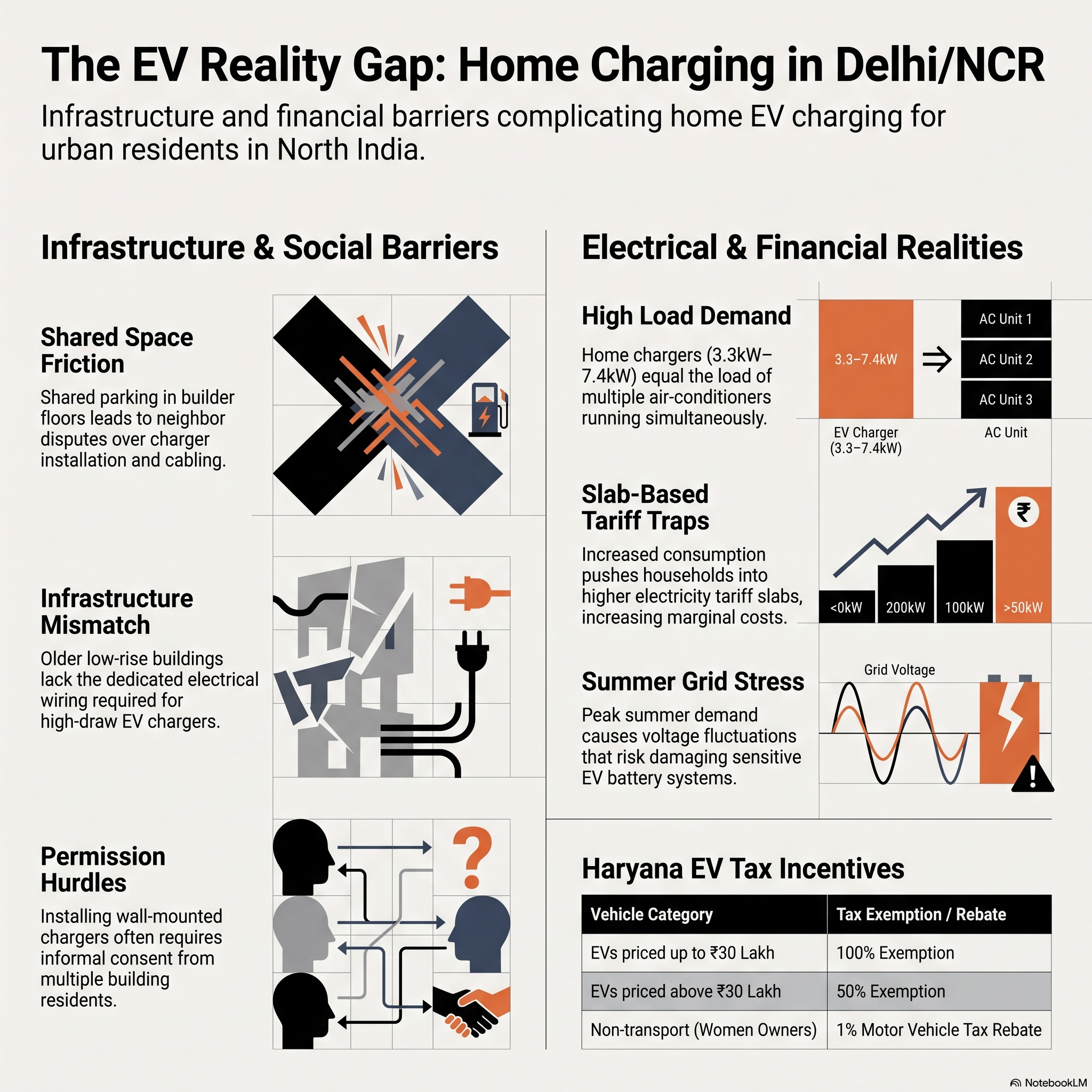
- 100% exemption from motor vehicle tax for new electric vehicles priced up to ₹30 lakh.
- 50% exemption for electric vehicles priced above ₹30 lakh.
- A 1% motor vehicle tax rebate on eligible non-transport vehicles registered in the name of women (up to ₹20 lakh ex-showroom).
These are positive measures that reduce the upfront cost of buying an EV. They deserve credit. However, they do not eliminate the practical ownership challenges discussed in this article.
So why not an electric vehicle, right now?
This hesitation is not ideological. It is grounded in practical, lived realities. The kind that brochures, launch events, and national-level EV statistics tend to gloss over. One of the biggest gaps between promise and practice lies in something very basic: charging the car at home.
The assumption that “home EV charging is easy”
Most EV conversations in India casually assume that home EV charging neatly solves all problems. The idea sounds simple. Plug in your car at night, wake up to a full battery, and never visit a petrol pump again.
That assumption works well in a few specific scenarios: independent houses with ample parking, planned societies with modern electrical infrastructure, or premium apartments that were designed with EV charging in mind. A large number of urban homes in Delhi/NCR do not fall into these categories.
Living in a builder floor changes the equation
Builder floors are extremely common across Haryana, especially in Gurugram, Faridabad, and emerging urban pockets. These are typically low-rise buildings with multiple independent floors, shared or semi-shared parking, and electrical infrastructure designed years before EVs were a serious consideration.
Charging an electric car in such a setup raises several questions.
First is the issue of parking. Many builder floors have open stilt parking or informal arrangements. Dedicated parking spots with clear ownership are not always guaranteed. Running a charger cable across common areas can become a source of daily friction with neighbors.
Second is permissions. Installing a wall-mounted charger often requires consent from other residents of the building. Even when people are supportive in principle, execution tends to get stuck in informal objections and delays.
Third, and most importantly, is electricity load.
Existing electricity connections may not be sufficient
Most residential electricity connections in builder floors are sized for conventional household usage. Lighting, fans, air-conditioners, refrigerators, washing machines, and televisions were the baseline assumptions.
An electric car adds a completely new category of load.
A typical home EV charger draws anywhere between 3.3 kW to 7.4 kW, depending on the car and charger type. In many homes, that is equivalent to running multiple air-conditioners simultaneously for several hours.
For houses already close to their sanctioned load of typically 10-12 kW, adding an EV charger can push the system beyond its limits.
This often means applying for a load enhancement with the electricity distribution company. On paper, this is straightforward. In practice, it involves paperwork, inspection visits, possible rewiring, meter upgrades, and additional security deposits.
None of this is unmanageable, but it adds cost, time, and uncertainty to what is often presented as a seamless transition.
Load enhancement has cascading implications
Increasing sanctioned load is not just a one-time technical decision. It has long-term financial consequences.
Higher sanctioned load often comes with higher fixed charges on the electricity bill. Even if your actual consumption does not spike every month, the baseline cost of having a larger connection remains.
In older builder floors, internal wiring may not be designed to handle sustained high loads. This can mean additional expenses for upgrading cables, distribution boards, and earthing systems to ensure safety.
For tenants, the situation becomes even more complex. Landlords may be reluctant to approve permanent electrical changes for a car they do not own.
Electricity bills and slab-based pricing matter
One of the strongest arguments for EVs is lower running cost per kilometer. While this is broadly true, it often ignores how residential electricity billing actually works.
In Haryana, like in many Indian states, electricity tariffs are slab-based. The more units you consume, the higher the per-unit cost becomes beyond certain thresholds.
Adding an electric car can significantly increase monthly electricity consumption. A car driven regularly can add anywhere between 150 to 300 units per month, sometimes more.
This additional usage can push households into higher tariff slabs, where each extra unit costs substantially more than the lower slabs.
The result is that the marginal cost of charging the car may be higher than the average household electricity rate that people casually use in calculations.
Over time, this does not negate the cost advantage of Eelectric Vehicles entirely, but it certainly narrows the gap. It also makes monthly bills more volatile, especially in summer months when air-conditioning usage is already high.
Peak load and summer stress on the grid
In North India, summers are unforgiving. During peak heat, residential electricity demand spikes sharply due to air-conditioners and coolers running for extended hours.
Adding overnight EV charging into this mix increases strain on local transformers, especially in older colonies and builder floor clusters where infrastructure upgrades have lagged behind population growth.
While utilities are planning upgrades, the reality on the ground is that power cuts and voltage fluctuations are still common during extreme weather. The voltage fluctuation fear is quite real as occasionally appliances get spoilt.
An EV that cannot be reliably charged at home during peak summer weeks loses a significant part of its appeal. Voltage fluctuations might damage the battery or the charging system
Fast charging is not a perfect fallback
One might argue that public fast chargers can compensate for home EV charging limitations. In theory, yes.
In practice, fast chargers in Haryana are still concentrated in specific corridors, malls, and premium commercial locations. Their availability, uptime, and queue management remain inconsistent.
Fast charging is also more expensive than home charging. Frequent reliance on it erodes the cost advantage and accelerates battery wear, which brings us back to long-term ownership concerns.
Battery longevity in real Indian conditions remains an open question
Battery warranties sound reassuring, but they are not a complete answer.
Most warranties cover capacity degradation up to a certain threshold over a fixed number of years. What they do not fully capture is how batteries behave under sustained heat, frequent fast charging, and fluctuating power quality.
The climate in Delhi and Haryana, combined with dust and summer peaks, is a tough environment. Long-term, real-world data for EV batteries under these conditions is still limited.
Until there is broader evidence from cars that have completed eight to ten years on Indian roads, this uncertainty remains.
Service ecosystem gaps still matter
Electric vehicles are mechanically simpler, but that does not eliminate service concerns.
Authorised service centers are still fewer and more concentrated in major cities. Skilled technicians, spare parts availability, and roadside support coverage are uneven, especially once you move away from NCR’s core zones.
For households that rely on a single car for daily mobility, reliability matters more than innovation. For families that have more than one car, an electric car especially in Delhi/NCR can be a good option if your charging issues are sorted.
Policy support is strong, but stability is still evolving
Government support for EVs is real and welcome. However, incentives, subsidies, and state-level policies continue to change.
For a consumer making a large financial decision, this creates uncertainty. Waiting allows policies to mature, charging standards to stabilize, and market competition to bring prices down more organically. The market currently has very limited options for small electric cars (under 4 meters) with real world range of 250-300 kms that would be ideal for an office goer looking to charge the car once a week.
When waiting stops making sense
I would seriously reconsider once a few conditions are met:
- Builder floors and housing societies routinely support EV charging without friction
- Electricity infrastructure upgrades become proactive rather than reactive
- Tariff structures evolve to account for EV charging without penal slab jumps
- Long-term battery performance data in Indian conditions becomes widely available
- Resale markets for used EVs gain depth and transparency
- And better charging infrastructure that gives confidence to use the EV for road trips especially to slightly off-beat places.
At that point, electric cars will feel less like a calculated experiment and more like a natural upgrade.
Electric cars represent the right direction for personal mobility in India. The question is not whether they make sense, but when they make sense for a specific household. For many residents of Haryana, especially those living in builder floors with constrained infrastructure, the transition is not as effortless as it is often portrayed.
Waiting, in this context, is not resistance to change. It is simply choosing practicality over optimism. The Haryana government’s recent tax exemptions and plans to simplify EV subsidies deserve credit. They lower the cost of ownership and send a positive signal to buyers.
But affordability is only one part of the ownership experience. For many families living in builder floors across Haryana and Delhi NCR, charging infrastructure at home, electrical load capacity, parking arrangements, and long-term operating costs remain equally important considerations.
When these practical issues become as easy to solve as paying for the car itself, I will happily join the electric revolution. Until then, waiting still feels like the more sensible choice.