
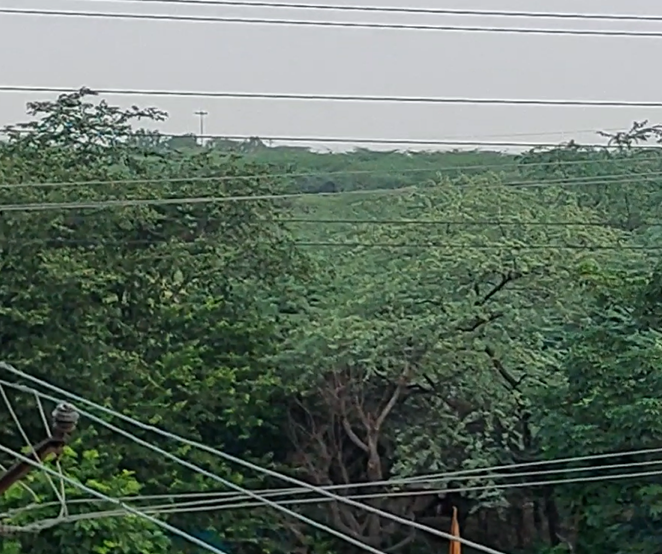
Every morning, I wake up to something that many people would envy: a beautiful view of the Aravalli forest from my builder floor. It is across a road beyond which is a designated forest area, which is soothing to the eyes and better air quality than most of Delhi/NCR. The changing seasons, the calls of birds, peacocks wandering through the trees, the occasional deer and the greenery make it one of the best parts of living here. The video below gives a quick overview. Additionally, the direction is west and I get to enjoy awesome sunsets in the evening.
There is one challenge, though. We regularly receive visitors that nobody invited. Monkeys.
Like many residential communities built close to forests, ours experiences frequent monkey visits. Sometimes they simply pass through. At other times they explore balconies, rooftops, and terraces looking for food.
Rather than asking how we can remove the monkeys, I started thinking if we can remove the reasons that make them venture out of the forest.
View the related YouTube video for this post.
Why Are Monkeys Entering Residential Areas?
It is easy to assume that monkeys are becoming more aggressive or more dependent on humans. The reality is usually more complicated.
As cities expand, forests become fragmented. Natural food sources may decline, and human settlements provide something that wildlife quickly learns to exploit: easy food, open garbage bins, people feeding animals and fruit trees inside residential colonies.
From a monkey’s perspective, a housing colony can become a very attractive place to visit.
An Idea That Came to Mind
One possible long-term solution seemed obvious was the thought of planting more native fruit-bearing trees inside the forest, especially in degraded areas near the boundary? If monkeys have more natural food available, perhaps they would have less reason to cross into residential neighbourhoods.
It sounds logical, but things especially ecology are rarely that simple.
Planting native trees offers several benefits.
Better habitat for wildlife: Native trees support not just monkeys but also birds, butterflies, squirrels, insects and countless other species.
Long-term forest restoration: Many parts of the Aravalli landscape have been degraded over decades. Restoring native vegetation helps improve biodiversity and soil quality.
A healthier ecosystem: A diverse forest is generally more resilient to drought, invasive species and climate change.
There are also reasons why tree planting alone may not solve the monkey problem.
More food can support larger monkey populations: If food availability increases significantly, the local monkey population may also increase over time.
Trees take years to mature: Most native trees require several years before they produce meaningful amounts of fruit.
Human food is still easier: Even when forests contain natural food, monkeys often choose the easiest option. An overflowing garbage bin usually beats climbing several trees.
Location, location and location: Planting fruit trees immediately next to residential buildings may unintentionally attract wildlife closer to homes.
Which Trees Are Suitable for the Aravallis?
Instead of planting commercial orchard species, restoring native vegetation is likely to deliver better ecological outcomes. Some excellent native species include:
| Species | Benefits |
|---|
| Dhau (Anogeissus pendula) | One of the dominant native Aravalli trees. Excellent for restoring degraded forest. |
| Ber (Ziziphus mauritiana) | Native fruit eaten by monkeys, birds and many mammals. Hardy and drought tolerant. |
| Gular (Ficus racemosa) | Excellent wildlife tree. Fruits several times a year and supports dozens of bird species. |
| Peepal (Ficus religiosa) | Produces figs that many birds and monkeys eat. Very valuable ecologically. |
| Banyan (Ficus benghalensis) | One of the best long-term food trees for wildlife, provided there is enough space. |
| Neem (Azadirachta indica) | Good shade tree that supports biodiversity, though not primarily a food tree. |
| Khejri (Prosopis cineraria) | Native to the region and highly resilient. |
| Ronj (Acacia leucophloea) | Common in the Aravallis and good for ecological restoration. |
Among these, fig trees such as Peepal, Banyan and Gular are particularly valuable because they produce fruit during different times of the year and support a wide variety of wildlife.
A Better Long-Term Approach
If I had the opportunity to contribute to improving this area, I would focus on a combination of measures rather than a single solution. These would include:
- Restoring degraded forest patches with native trees.
- Preventing further encroachment into the forest.
- Installing monkey-resistant garbage bins.
- Discouraging people from feeding wildlife.
- Working with the Forest Department and local resident associations on habitat restoration.
Living Alongside Nature
One thing I have realised is that living next to a forest is a privilege as well as a responsibility. We enjoy cleaner air, beautiful views and rich biodiversity. In return, we must accept that wildlife was here long before our homes were built. The challenge is not to eliminate wildlife from our surroundings but to create conditions where people and wildlife can coexist with fewer conflicts.
Planting native trees may not eliminate monkey visits overnight. However, as part of a broader conservation effort, it is an investment that could benefit the Aravallis, its wildlife, and future generations.
What do you think? If you live near a forest or wildlife corridor, have you experienced similar challenges? I would love to hear your thoughts and ideas in the comments.
Disclaimer: wildlife management should be undertaken in consultation with the Forest Department, and that residents should never feed wild monkeys